
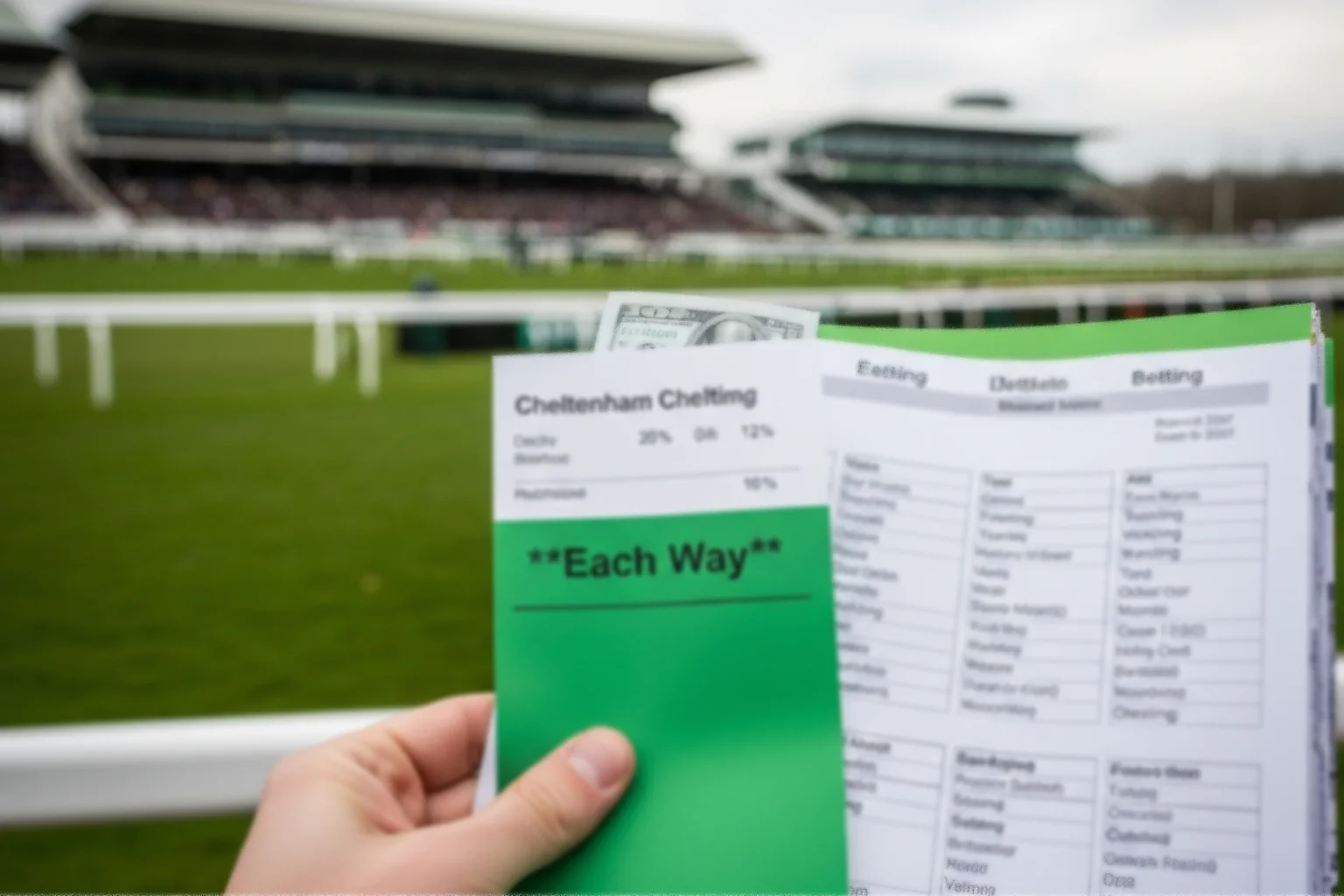
Every Cheltenham Festival, the same question echoes across betting shops and mobile apps: should I back it to win, or play it safe each-way? For the majority of punters, the answer tilts heavily toward each-way — and for good reason. When you are staring at a 20-runner handicap hurdle where the favourite has an 8% historical win rate, putting your entire stake on a single outcome feels less like strategy and more like hope.
Each-way betting gives you two chances from a single selection: one bet on the win, one on the place. It is the most popular bet type across the festival’s big-field handicaps, and it has been a cornerstone of Cheltenham wagering for decades. The average win or each-way stake at the festival sits around £8.22 according to OpenBet processing data from 2022 — meaning the real cost of an each-way bet is roughly £16.44. That is not pocket change across 28 races, so understanding when each-way offers genuine value and when it simply doubles your losses is worth the effort.
Two chances to win from every selection. That is the promise. Whether it delivers depends entirely on which races you target and how you read the place terms.
How Each-Way Betting Works
An each-way bet is two separate bets rolled into one: a win bet and a place bet. If your horse wins, both parts pay out. If it finishes in a place position but does not win, you lose the win stake but collect on the place part. If it finishes outside the places entirely, you lose both stakes. Simple enough — but the maths underneath matters more than most punters realise.
The place part of your bet pays at a fraction of the win odds. That fraction is determined by the place terms, which vary depending on the number of runners in the race. At Cheltenham, the standard terms are one-quarter of the win odds for races with five to seven runners and one-fifth of the win odds for handicap races with eight or more runners. Some bookmakers offer enhanced place terms — one-quarter instead of one-fifth on selected handicaps — as a promotional tool, and these offers can meaningfully shift the value equation.
Here is how the return works in practice. Suppose you back a horse at 10/1 each-way, £5 each way (total stake £10). The place terms are one-fifth the odds. If the horse wins, you collect £50 profit on the win part plus £10 profit on the place part (10/1 divided by 5 = 2/1, so £5 at 2/1 = £10), giving you £60 profit on a £10 total stake. If the horse finishes second or third but does not win, you lose the £5 win stake and collect £10 from the place part, leaving you with £5 profit overall. That profit might not sound dramatic, but across a four-day festival with multiple selections, those place returns accumulate and keep your bankroll alive.
The crucial detail punters often overlook is the relationship between the win odds and the place fraction. At short prices — say 2/1 — an each-way bet on one-fifth terms means the place part pays only 2/5. Backing a 2/1 shot each-way for it to finish second effectively gives you odds of 2/5 for that outcome, which is poor value in almost every scenario. Each-way betting is structurally designed for bigger-priced horses. The longer the odds, the more meaningful the place return becomes.
One more mechanical point: each-way bets cannot be split between bookmakers. Both the win and place parts must sit with the same firm. This matters when you are comparing odds, because the best win price and the best place terms may not live at the same bookmaker. Choosing which matters more depends on whether you genuinely expect your horse to win or whether you are primarily hunting for a place return.
Place Terms at Cheltenham
Place terms at Cheltenham follow the standard industry structure but with important variations driven by field sizes and bookmaker promotions. Getting this right is not optional — it is the entire basis of each-way value.
In races with five to seven runners, bookmakers typically pay two places at one-quarter of the win odds. With eight or more runners, the standard shifts to three places at one-fifth the odds. Once a race has 16 or more runners — which happens regularly in Cheltenham’s marquee handicaps — the standard terms extend to four places at one-quarter the odds. Some of the festival’s biggest fields, particularly the County Hurdle and the Coral Cup, routinely attract 20-plus runners, pushing the place count to four and making each-way a genuinely attractive proposition.
Where things get interesting is the extra places market. Several bookmakers offer enhanced terms on selected Cheltenham races as a promotional tool. An extra place — paying five places instead of four in a big-field handicap — can transform marginal each-way value into a positive-expectation bet. Bookmakers absorb the cost because it drives volume and new sign-ups during the festival. For punters, it is free value hiding in the promotional small print.
The distinction between handicap and non-handicap races matters enormously here. Championship races — the Champion Hurdle, Queen Mother Champion Chase, Gold Cup — typically attract small fields of eight to twelve runners. Three places at one-fifth the odds on a short-priced favourite is rarely exciting. By contrast, the festival’s open handicaps routinely field 16 to 24 runners, where four places at one-quarter odds makes each-way betting structurally more rewarding. The takeaway is straightforward: each-way betting at Cheltenham belongs in the handicaps. In championship races, you are generally better off backing to win outright or looking at place-only markets.
Best Races for Each-Way Betting at Cheltenham
Not every Cheltenham race suits an each-way approach. The festival’s 28 races span everything from small-field Grade 1 championship events to sprawling handicaps with two dozen runners, and the each-way logic shifts dramatically between them.
The Coral Cup is the each-way punter’s playground. Favourites have won this race just twice in 25 runnings — an 8% strike rate that tells you everything about the competitive nature of big-field handicap hurdles at Cheltenham. When the market leader wins less than one in twelve editions, the race is practically begging for each-way betting on mid-range and longer-priced contenders. The County Hurdle follows a similar pattern: large fields, compressed form, and a history of surprises. The Martin Pipe Conditional Jockeys’ Handicap Hurdle, which closes the festival on Friday, is another race where the each-way approach thrives — it regularly attracts big fields and produces winners at double-figure odds.
On the other side of the spectrum, backing a 6/4 favourite each-way in the Champion Hurdle — a race with 10 runners and three places at one-fifth the odds — is mathematically questionable. The place return is tiny relative to the doubled stake. If you fancy the favourite in a championship race, back it to win. If you are looking to oppose the favourite, an each-way bet on a 10/1 or 12/1 contender in the same race can work, but only if the field size justifies reasonable place terms.
A practical framework: target races with 16 or more declared runners, where four places are paid and the favourite is 5/1 or bigger. At Cheltenham, that typically means the Coral Cup, County Hurdle, Ultima Handicap Chase, Plate, Kim Muir, and Martin Pipe. These are the contests where each-way betting is not just viable but arguably the optimal approach. In everything else, consider whether the place terms genuinely justify doubling your stake — or whether a straight win bet gives you cleaner value.
Keeping Each-Way Costs in Check
Each-way betting doubles your stake on every selection. Over four festival days and multiple bets, costs add up faster than most punters expect. Set a daily budget before the festival begins and stick to it regardless of results. If you find yourself chasing losses or increasing stakes to recover, step back. Gambling should be entertainment, not a financial strategy. If you need support, contact BeGambleAware or call the National Gambling Helpline on 0808 8020 133. Resources are free, confidential, and available around the clock.