
 Available in US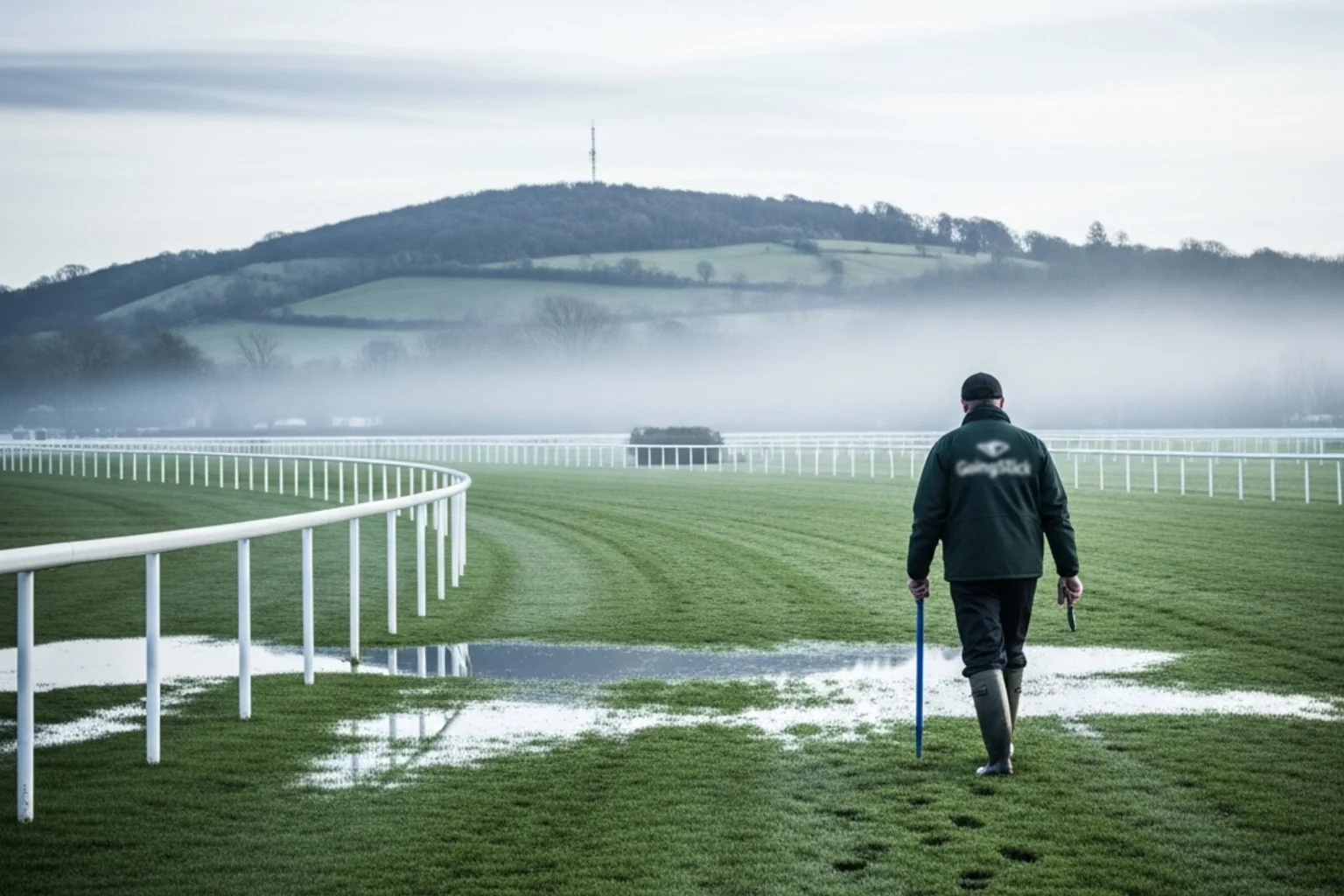
- Why Ground Conditions Decide More Races Than Form
- The GoingStick — Cheltenham's Ground Truth Instrument
- How Each Ground Type Changes the Race
- Old Course vs New Course — How Going Plays Differently on Each Track
- Tracking the Weather Before the Festival
- Barrier Adjustments in 2026 — What Changed and Why
- Making Going-Adjusted Selections — a Practical Method
- No Analysis Removes Racing's Uncertainty
Why Ground Conditions Decide More Races Than Form
Cheltenham 2026 began on ground officially described as Good to Soft, following a winter that was wetter than average and a programme of selective watering designed to prevent the surface drying out unevenly. For the first time in years, the positions of the final hurdles on both the Old and New Courses were moved back due to waterlogged patches — a technical adjustment that most pre-festival coverage barely mentioned but that directly affects how horses jump and finish. Ground conditions at Cheltenham are not a footnote. They are a primary variable, and in a festival where the starting favourite loses roughly seven races out of ten, getting the going wrong is one of the fastest ways to eliminate your edge.
Most tipsters treat the going as a secondary consideration, something to check after they have already formed an opinion. The approach here is the opposite. The going is the starting point — the environmental context that shapes which horses are suited, which are disadvantaged, and which are running on their least preferred surface. Over the next sections, we will examine how the going is measured, what each type of ground does to a race, how the two Cheltenham courses respond differently to the same weather, and how you can use this information to filter your selections before race day. The ground tells a story. The question is whether you are reading it before you bet.
Ground suits some tracks more than others: course comparison.
The GoingStick — Cheltenham’s Ground Truth Instrument
The going at a British racecourse is not assessed by a person walking the track and offering an opinion, though that tradition persisted for decades. Today, the primary instrument is the GoingStick — a penetrometer that measures the resistance of the turf to pressure. It produces a numerical reading on a scale from 1 to 15, where 1 represents the heaviest, most waterlogged ground and 15 the driest, firmest surface. The clerk of the course takes multiple readings at different points around the track, and the average forms the basis of the official going description.
The GoingStick reading ahead of Cheltenham 2026 was 6.2 on the Old Course, which translates to a description of Good to Soft, Good in places. That phrase — seemingly straightforward — contains significant information. It tells us the ground is on the softer side of the middle range, with patches of better ground, likely on higher or better-drained sections of the track. Horses with a proven record on Good to Soft are better suited than those that need quicker going, and the “Good in places” qualifier means the inside rail, where drainage is typically better, may ride marginally faster than the wider line.
The GoingStick scale maps to the traditional going descriptions used in British racing as follows. Readings of 1 to 3 correspond to Heavy — ground that demands extreme stamina, slows times dramatically, and punishes speed horses. Readings of 3 to 5 translate to Soft, where the surface is testing but not bottomless. The 5 to 7 range covers Good to Soft, the default Cheltenham March condition — ground with enough give to reward jumping ability and stamina without being so demanding that it becomes a slog. Good sits at 7 to 9, where the balance shifts toward speed and agility. Good to Firm covers 9 to 12, increasingly rare at Cheltenham in March but not unheard of during dry springs. Firm, at 12 to 15, is essentially never seen at the festival and would prompt serious concern about horse welfare if it were.
The Racing Post maintains a model that cross-references GoingStick readings with observed race times and finishing patterns. This model allows them to predict how ground changes during the day — as thousands of hooves churn the turf and weather intervenes — will affect later races. For punters, the critical window is the morning of each race day. GoingStick readings are typically published before 8am, and the official going is updated based on those numbers. A reading that has dropped overnight — from 6.5 to 5.8, say — signals that the ground has taken on rain and is riding slower than the previous day. Any horse in your shortlist that struggles on softer ground becomes a concern.
Understanding the GoingStick is not optional at Cheltenham. It is the instrument that converts subjective impressions about “how the ground looks” into numerical data you can match against a horse’s record. Every runner in every Cheltenham race has a going history: a list of previous performances on different surfaces, recorded in the form book. The GoingStick reading is the key that unlocks that history and tells you whether today’s surface suits the horse or works against it.
How Each Ground Type Changes the Race
Each band on the going scale produces a different kind of race, and knowing what to expect from the ground shapes everything from selection to staking.
Heavy ground is the great equaliser. When the surface is saturated, every stride requires more effort, every jump demands more energy on landing, and the race becomes a test of raw stamina above all else. Speed horses — the ones who win by quickening in the final two furlongs on good ground — are neutralised. Staying types, horses with deep reserves of endurance and an ability to grind through energy-sapping conditions, come to the fore. Races on heavy ground tend to produce bigger-priced winners because the conditions compress the field, turning a ten-length superiority on good ground into a two-length margin at best. For punters, heavy going is an opportunity to look beyond the obvious — the horses who would be certainties on faster ground may struggle, while unfancied stayers suddenly become contenders.
Soft ground shares many of these characteristics but with less extreme consequences. The surface is demanding without being bottomless, and while stamina is still rewarded, horses with a blend of speed and endurance can cope. Cheltenham sees Soft ground in roughly one festival year in four, typically when March has been persistently wet. When it arrives, look at a horse’s form on Soft specifically — not just on any cut in the ground, but on ground described as Soft or worse. Some horses who handle Good to Soft comfortably find Soft a step too far; others thrive when the going deteriorates.
Good to Soft is the default Cheltenham condition and the one that most festival form has been produced on. It is the band that rewards all-rounders: horses with enough stamina to handle the hill, enough speed to finish, and enough jumping ability to stay balanced on a surface that gives slightly under foot. Because this is the most common going, it is also the most predictable for punters — the majority of trends and statistics you will find about Cheltenham performance have been compiled primarily on Good to Soft ground. The 2026 festival starting on this surface means historical patterns apply more directly than they would on extreme going.
Good ground tilts the balance toward speed. Races on Good tend to be faster, gaps between horses larger, and front-runners more dangerous because they expend less energy maintaining position. At Cheltenham, Good ground is less common in March than Good to Soft but arrives after dry spells. When it does, the form profiles of the leading contenders may shift: a horse with an outstanding record on Good but untested on cut ground becomes a more attractive proposition.
There is a secondary interaction between going and race type that the data supports. On Champion Day — Tuesday — favourites win roughly 37% of races, the best rate of any festival day. Part of the explanation is that Tuesday’s card is weighted toward championship (non-handicap) races where class dominates. But part of it may also relate to going: the ground is at its freshest on Tuesday, least churned, closest to the official description. By Friday, after three days of racing and potential weather changes, the surface has evolved — sometimes dramatically — from its initial state. This progressive deterioration adds another variable to later-week selections that Tuesday punters do not have to account for.
Old Course vs New Course — How Going Plays Differently on Each Track
Cheltenham operates two distinct track configurations — the Old Course and the New Course — and the going affects each differently, which is a subtlety most preview articles overlook entirely.
The Old Course is the tighter of the two layouts. Its fences and hurdles are positioned on a slightly different line, the bends are sharper, and the run-in from the final obstacle to the winning post is shorter. Crucially for going purposes, the Old Course drains more efficiently. Its terrain sits marginally higher relative to the water table, and the turf tends to retain less moisture after rain. In practical terms, this means that when the official going is described as Good to Soft across the course, the Old Course rail may ride closer to Good, particularly on the better-drained inner line. Horses who prefer faster ground can find an advantage on the Old Course even when the overall description suggests cut.
The New Course presents a different challenge. It is wider, with a longer run-in that favours horses with a sustained turn of foot rather than those who rely on a quick burst of speed. Cheltenham Hill — the steep, famously testing climb that separates the final two fences from the winning post — is marginally more punishing on the New Course layout because the angle of approach and the wider track encourage horses to race wider, covering more ground on the uphill stretch. On soft going, this combination of width and gradient becomes severe. Horses that lack stamina or are not fit enough to sustain effort through heavy ground up the hill find themselves exposed in the final furlong in a way that the Old Course’s tighter configuration somewhat mitigates.
For punters, the practical application is to cross-reference the going with the course configuration for each day’s racing. The festival schedule alternates between the two courses across the four days: some races use the Old Course, others the New Course, and the racecourse publishes the configuration in advance. A horse with strong form on Good to Soft ground running on the Old Course has, in effect, a slight surface advantage over a horse with similar form running on the New Course in the same conditions. That edge is narrow, but across 28 races it compounds — and in a festival where margins of one or two lengths regularly decide outcomes, narrow edges are worth having.
Seven-year-old horses that have previously won at Cheltenham carry a 28% strike rate since 2013, one of the strongest course form signals in the data. Part of this likely reflects experience with the specific demands of each course configuration under specific going conditions. A horse that has handled the New Course on Soft and returned to do it again knows the hill, knows the going, and knows what the last half-mile demands. That combination of course form and going experience is a filter that goes beyond raw finishing positions.
Tracking the Weather Before the Festival
Ground conditions at Cheltenham are not fixed for the week. They evolve — sometimes hour by hour — as weather systems pass over the Cotswolds and thousands of hooves churn the turf between races. Tracking the weather before and during the festival is not a luxury for the obsessive; it is a basic component of informed betting.
The Met Office five-day forecast, available freely online, is the starting point. By the weekend before the festival, the forecast is detailed enough to distinguish between days — a dry Tuesday followed by rain on Wednesday, for example, changes the going profile dramatically for the second half of the week. Racing Post and Sporting Life publish dedicated going and weather updates for Cheltenham in the build-up, incorporating GoingStick readings, rainfall data, and official statements from the clerk of the course.
The Jockey Club, which operates Cheltenham racecourse, also employs a watering policy that is worth understanding. If the ground is drying faster than desired — heading toward Good or Good to Firm — the course management can irrigate specific areas to maintain the surface in the Good to Soft range that most trainers and the racecourse prefer. Selective watering was applied before the 2026 festival precisely for this reason: a dry spell in early March risked the ground firming up beyond the ideal range, and the management team intervened. Conversely, if the ground is too soft, there is little that can be done except wait for it to dry naturally. This asymmetry means that Cheltenham’s going has a soft-side bias — the course management can prevent the ground getting too fast but cannot easily prevent it getting too slow.
For punters, the practical routine is straightforward. Check the Met Office forecast on the Sunday before the festival. Read the Monday going update from Racing Post or Sporting Life. On each race morning, check the updated GoingStick reading (typically available by 8am). Compare that reading to your horses’ going preferences. If the ground has changed overnight — a common occurrence in the unpredictable March climate of western England — reassess your selections before the first race. The ten minutes this takes can save you from backing a horse that is running on a surface it has never handled.
The full picture is in our Cheltenham betting tips.
Barrier Adjustments in 2026 — What Changed and Why
One of the less publicised developments ahead of Cheltenham 2026 was the decision to move the positions of the final hurdles on both the Old Course and the New Course. Jon Pullin, the clerk of the course, explained that a wetter-than-average winter had created a problematic area of ground in the vicinity of the original hurdle positions. Moving the last flights back allowed horses to take a better racing line through the affected section, reducing the risk of injury and giving the damaged turf more time to recover.
This matters for punters in a specific way. The position of the final obstacle relative to the winning post affects how a race plays out in its closing stages. A hurdle closer to the finish demands a burst of speed immediately after jumping, favouring horses with a quick change of gear. A hurdle further from the finish extends the run-in, favouring stayers who can grind out the final yards without the disruption of a late jump. The 2026 adjustments lengthened the run-in on both courses, which in theory slightly favours staying types and galloping horses over nimble, speed-oriented runners.
The adjustment also interacts with the going. On soft ground, a longer run-in after the final hurdle is more testing — the horse has to sustain effort through energy-sapping turf for a greater distance without the momentum boost that clearing an obstacle provides. Combine this with the Good to Soft conditions expected for 2026 and the New Course’s demanding hill, and the profile shifts further toward horses with proven stamina on testing ground. If you are choosing between two contenders for a New Course hurdle race and one has deeper stamina reserves, the barrier move gives that horse a fractional but real advantage that was not present in previous years.
Whether the barrier positions revert to their original locations in future years will depend on the condition of the ground. For 2026, the change is confirmed and should be factored into any assessment of hurdle races on both courses.
Making Going-Adjusted Selections — a Practical Method
What follows is a method for integrating going data into your Cheltenham selections. It does not replace form analysis — it refines it.
Step one: check the morning GoingStick reading. On each race day, the Cheltenham racecourse and the Racing Post publish the latest reading before 8am. Note the number and the corresponding description. If the reading has changed from the previous day, pay attention — a drop of 0.5 or more suggests meaningful rainfall overnight.
Step two: cross-reference with each horse’s going record. For every horse on your shortlist, check its previous runs on the current going type. A form book entry will typically note the going for each start: Good, Good to Soft, Soft, Heavy. You want to see at least one previous run on ground matching today’s description, and ideally a finishing position in the first four. A horse that has never raced on Good to Soft, running on Good to Soft for the first time at Cheltenham, carries an unknown variable that the market may not fully price in.
Step three: adjust for course configuration. Check whether the race is on the Old Course or the New Course. As discussed above, the Old Course drains better and may ride marginally faster than the official going suggests. On a Good to Soft day, a speed horse on the Old Course has a better surface than the same horse on the New Course. Factor this into your assessment, particularly in hurdle races where the barrier adjustments in 2026 extend the run-in on both configurations.
Step four: consider trainer going preferences. Some trainers have documented preferences for specific ground conditions. Mullins, for example, has a history of running horses on soft or testing ground that other operations might avoid — his Closutton base in County Carlow prepares horses on surfaces similar to a wet Cheltenham, and his runners typically arrive fit for the conditions. Henderson’s horses, trained on the Lambourn gallops which drain quickly, may be more suited to faster ground. These are generalisations and should not override specific horse form, but they add a layer of context when two contenders appear closely matched on paper.
Step five: reassess after each day. The going will change across the four days of the festival. By Wednesday, the sections of track that hosted Tuesday’s racing will have been impacted by hooves, potentially riding slower than the official description. By Friday, the cumulative wear is significant. Reassess your selections for later in the week based on updated GoingStick readings, not on the conditions you observed on Tuesday. A horse you shortlisted for Friday on the assumption of Good to Soft may find itself facing Soft by the time Gold Cup day arrives, and that shift could be the difference between a contender and an also-ran.
Going analysis is not glamorous. It does not produce the thrilling narrative of a Gold Cup contender profile or the excitement of a jockey booking. But it is the variable that most punters underweight and that most upsets can be traced back to. If you do nothing else before placing a Cheltenham bet, check the ground.
No Analysis Removes Racing’s Uncertainty
Going analysis can improve your selections, but no analytical method removes the fundamental uncertainty of horse racing. Conditions change, horses respond unpredictably, and results are never guaranteed. Bet within your means and treat any analytical framework as a tool for better decisions, not a promise of profit. If you need support, GambleAware and GamCare provide free, confidential advice. The National Gambling Helpline number is 0808 8020 133.
