
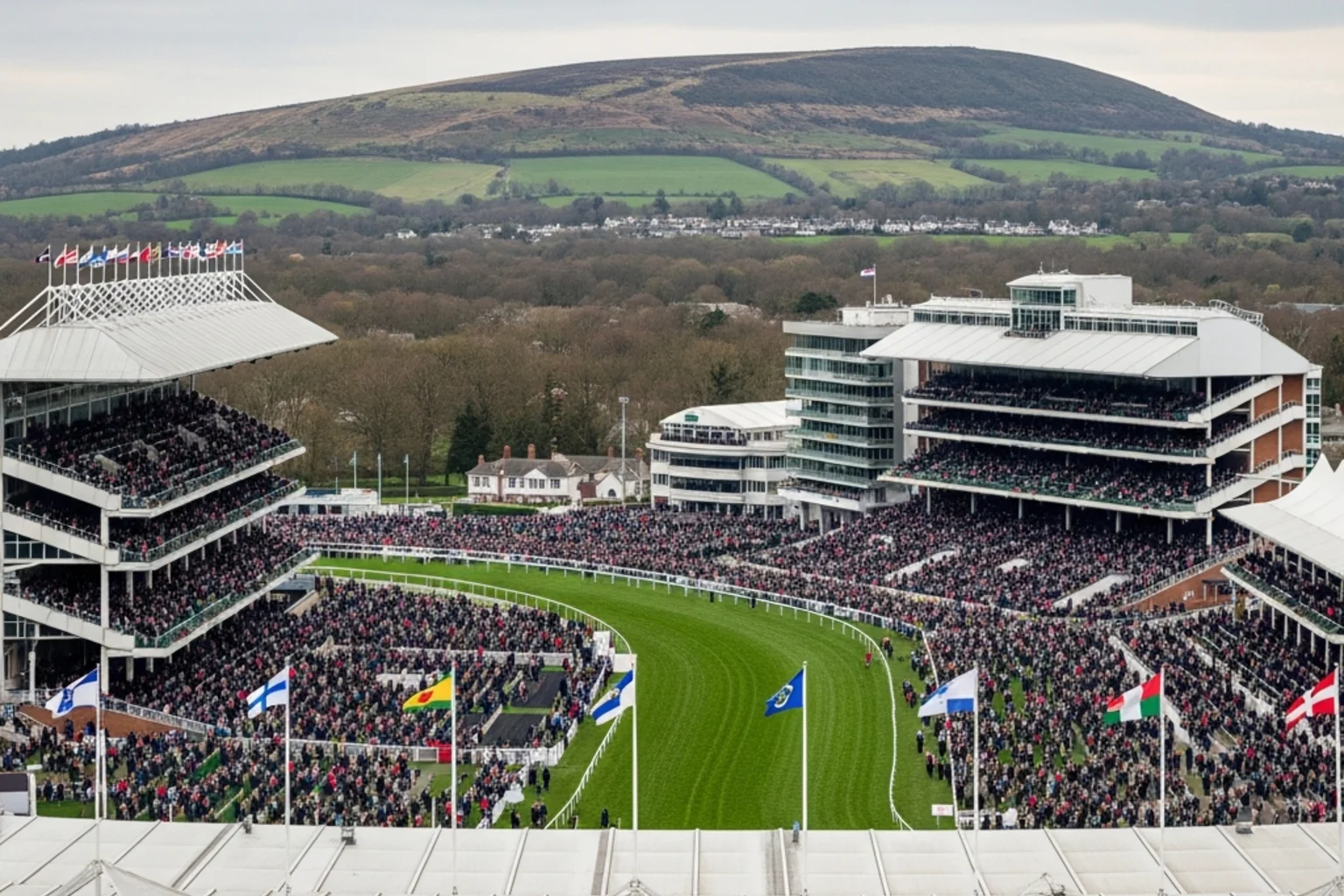
Four days that stop the racing world. Every March, the Cotswolds village of Prestbury Park transforms into the epicentre of jump racing as the Cheltenham Festival draws trainers, jockeys, punters, and spectators from across Britain and Ireland. It is the sport’s championship meeting — the week where reputations are made, careers are defined, and a year’s worth of planning comes down to 28 races over four extraordinary afternoons.
The numbers tell part of the story: a £274 million economic impact on the local region in 2022, a record prize fund approaching £5 million, and hundreds of millions of pounds wagered across the four days. But numbers alone do not explain why Cheltenham matters. The festival occupies a unique position in British and Irish sporting culture — part tradition, part competition, part annual pilgrimage. Understanding what the festival is and how it works is the first step to engaging with it properly, whether your interest is sporting, financial, or both.
From Cleeve Hill to Prestbury Park — A Brief History
Racing at Cheltenham dates to the 1810s, when meetings were held on Cleeve Hill above the current site. The move to Prestbury Park came in 1902, and the festival in its modern form began to take shape through the early twentieth century. The Gold Cup was first run in 1924, the Champion Hurdle followed in 1927, and by the mid-twentieth century Cheltenham had established itself as the definitive test for National Hunt horses.
The 1960s brought Arkle — the horse who defined an era. Three consecutive Gold Cups between 1964 and 1966, won with a dominance that has never been matched, elevated the festival from a major racing event to a sporting institution. Arkle remains the standard against which every staying chaser is measured, and his statue at the racecourse serves as a permanent reminder of what greatness looks like over fences.
Dawn Run’s Champion Hurdle and Gold Cup double in 1984 and 1986 added another legendary chapter. Best Mate’s three consecutive Gold Cups between 2002 and 2004 echoed Arkle’s achievement and introduced the festival to a new generation of punters via expanded television coverage. More recently, Willie Mullins has reshaped the competitive landscape entirely. With 113 festival victories and counting — the all-time record — Mullins has turned the festival into a stage for Irish dominance that shows no sign of receding. The 2026 edition sees him enter 87 horses from 54 individuals, a depth of firepower that no British trainer can match.
The festival expanded from three days to four in 2005, adding what is now known as Gold Cup Day on Friday. This expansion increased the total race count to 28, broadened the programme to include more novice and mares’ races, and transformed the week into a genuine festival rather than a concentrated three-day meeting. Each expansion has brought more spectators, more betting volume, and more prestige.
The Economic Engine — £274 Million and Counting
The University of Gloucestershire, in partnership with the Jockey Club, estimated the festival’s total economic impact at £274 million in 2022 — a figure that had grown from approximately £100 million in 2016. The average visitor spent £697 across their festival attendance, up from £584 six years earlier. These are not just racing fans buying tickets: the spending spans accommodation, food and drink, transport, retail, and entertainment across the wider Cheltenham and Cotswolds region.
The research revealed that 67% of visitors considered the festival a bucket-list experience, while 53% were repeat attendees. That split between first-timers and regulars reflects the festival’s dual appeal — it is both a must-see event for newcomers and a deeply ingrained annual tradition for the racing community.
For 2026, the Jockey Club has reduced the daily capacity limit from 68,500 to 66,000, establishing a four-day ceiling of 264,000. This adjustment follows a period of attendance decline — total attendance fell to 218,839 in 2025, down 22% from the 2022 peak of 280,627. The new capacity cap reflects both safety considerations and a strategic shift toward improving the experience for those who do attend rather than maximising raw numbers.
The betting economy adds another layer to the festival’s impact. William Hill projects that approximately £450 million will be wagered across the four days of the 2026 festival, making Cheltenham the single largest betting event on the jump-racing calendar. That volume sustains the bookmaking industry, funds the prize money that attracts the best horses, and creates the competitive market that gives punters the opportunity to find value. The festival is not just a sporting event — it is an economic ecosystem where spectators, bettors, bookmakers, racecourse operators, and the wider Cotswolds hospitality sector are all interconnected.
28 Races, Four Days — How the Programme Works
The festival’s 28 races are divided across four themed days. Champion Day on Tuesday features the Supreme Novices’ Hurdle, the Arkle Chase, and the Champion Hurdle. Ladies Day on Wednesday includes the Queen Mother Champion Chase and the Coral Cup. Stayers’ Hurdle Day on Thursday centres on the Stayers’ Hurdle and the Ryanair Chase. Gold Cup Day on Friday builds toward the Cheltenham Gold Cup as the week’s climax.
Each day offers seven races, mixing Grade 1 championship events with handicaps, novice races, and specialist contests like the Cross Country Chase. The championship races — Champion Hurdle, Queen Mother Champion Chase, Stayers’ Hurdle, Ryanair Chase, and Gold Cup — attract the highest-rated horses and the most intense betting interest. The handicaps — Coral Cup, County Hurdle, Plate, Martin Pipe — draw the largest fields and produce the most unpredictable results.
The total prize fund for 2026 stands at a record £4,975,000, a 5% increase on the previous year. The Gold Cup alone carries a purse of £625,000, with £351,688 going to the winner. The Champion Hurdle is worth £450,000. These figures make Cheltenham the most valuable meeting in jump racing by a considerable margin, which in turn attracts the best horses from both Britain and Ireland.
The programme’s structure means each day has a distinct character. Tuesday is the best day for favourites historically, with predictable championship races anchoring the card. Wednesday hides value in less-scrutinised races. Thursday demands stamina assessment across staying events. Friday is the most volatile and the hardest day to call. Understanding these daily rhythms is essential for any punter looking to approach the festival with a structured strategy rather than a scattergun approach.
The festival also serves as the annual battle between British and Irish racing. The Prestbury Cup — a running tally of winners by country — has been dominated by Ireland for more than a decade. Irish trainers led by Mullins, Gordon Elliott, and Henry de Bromhead regularly account for more than half of all winners, despite entering fewer runners overall than the British contingent. This cross-channel rivalry adds a competitive layer that goes beyond individual races and shapes the entire festival narrative, from the ante-post markets to the celebrations on Friday evening.
Enjoying the Spectacle Within Your Means
The Cheltenham Festival is designed to be exciting — and that excitement can overwhelm good judgement. Set a total budget for the week before the festival begins, divide it across four days, and do not adjust it based on results. The spectacle of the festival should be enjoyed for what it is: a celebration of sport and competition. If betting stops being enjoyable or starts causing stress, step back. Support is available at BeGambleAware on 0808 8020 133, free and confidential.