
- Why the Name on the Racecard Matters More Than You Think
- Willie Mullins — the Festival's All-Time Record Holder
- Henderson, Skelton and the British Response
- Elliott and the Wider Irish Raiding Party
- Jockey Strike Rates — Who Delivers Under Pressure
- Level-Stake Profits — the Metric That Cuts Through the Noise
- The Prestbury Cup — Ireland vs Britain in Hard Numbers
- Statistics Inform, They Do Not Promise
Why the Name on the Racecard Matters More Than You Think
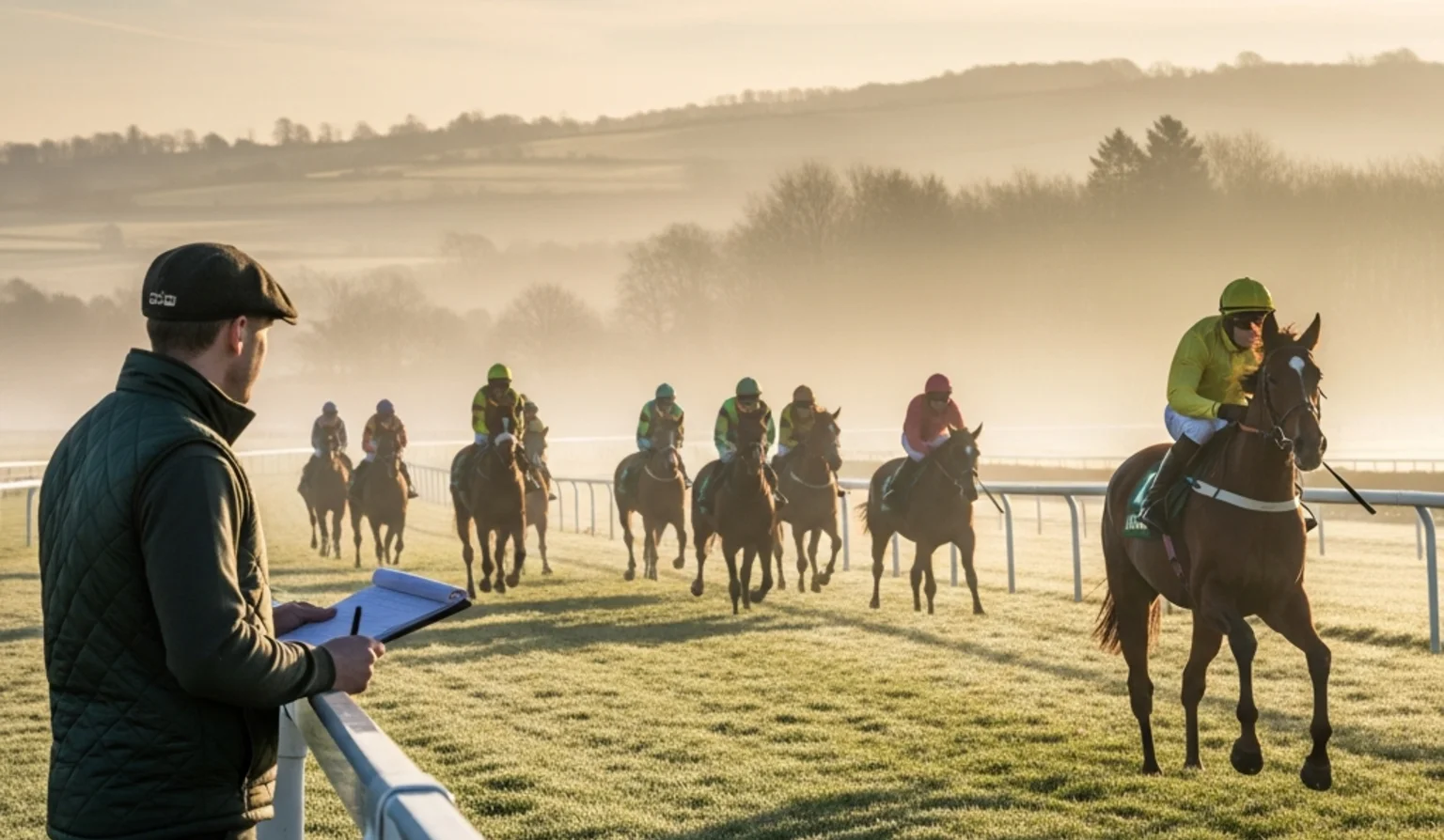
Cheltenham Festival is sometimes described as a test of horse against horse. It is more accurately a test of operation against operation — training regimes, support staff, veterinary programmes, race planning stretching back months, all compressed into four days of action on the Prestbury Park turf. The horse does the running. But the trainer chooses the race, manages the preparation, and decides whether the horse is ready. The jockey executes the plan under pressure that no other meeting in National Hunt racing quite replicates.
For punters, this means that trainer and jockey statistics are not background decoration. They are front-line data. A horse trained by a festival specialist and ridden by a jockey with a proven course record carries advantages that form figures alone cannot fully capture — advantages in preparation, in race craft, and in the ability to handle the uniquely demanding atmosphere of a Cheltenham crowd. The numbers that follow are drawn from official sources and verified databases, and they tell a story of one extraordinary dominance, a handful of credible challengers, and a cross-border rivalry that has reshaped how the festival is bet upon.
Willie Mullins — the Festival’s All-Time Record Holder
There is no polite way around it: Willie Mullins has broken the festival. His 113 career victories at Cheltenham are a record that no active trainer is remotely close to matching. He has been the leading trainer at eight of the last ten festivals. In 2025, he saddled ten winners — equalling his own single-festival record set in 2022. The scale is not just impressive; it has fundamentally altered the economics of Cheltenham betting.
For 2026, Mullins has entered 87 horses from 54 individuals across the programme, meaning multiple entries in a significant number of races. His five-year festival strike rate stands at 13.26% — 46 winners from 347 runners — which might sound modest until you consider the context. This is across all race types, including the deepest handicaps where any individual horse faces fields of 20 or more. Add in the 91 horses that finished second through fourth over the same period (a place rate of 26.2%), and the picture sharpens: roughly four in ten Mullins runners finish in the first four at Cheltenham. For a meeting where the average field size is twelve, that is a staggering concentration of competitiveness.
The historical dimension deepens the case. In the 2023-24 season, Mullins set a world record of 39 Grade 1 victories — a benchmark no trainer in any jurisdiction had previously reached. He also became the first Irish trainer to win the British trainers’ championship since Vincent O’Brien in 1954, a gap of seventy years. He defended that title in 2024-25, overtaking Dan Skelton on the final day of the season to retain the crown. These are not Cheltenham-specific statistics, but they speak to the depth and breadth of his operation. A trainer producing this volume of top-level winners across two countries is deploying resources — horses, staff, veterinary expertise, race planning — on a scale that no rival currently matches.
Mullins himself has described his operation as a “huge team operation,” noting that the sheer number of horses he brings to the festival would have been unimaginable a generation ago. That team approach matters for punters. With 87 entries spread across the programme, Mullins will have runners in nearly every race. Some will be first-string fancies; others will be speculative entries or pacemakers for stablemates. The challenge for bettors is distinguishing between the two — a question we will revisit when examining jockey bookings later in this guide.
The practical implication is blunt: ignoring Mullins at Cheltenham is ignoring the single strongest signal in the data. But backing every Mullins runner at short prices is not a profitable strategy either. His 13.26% strike rate means roughly seven in eight runners lose. The edge lies in identifying which Mullins horses are live contenders and at what price they represent value — a question that requires looking at race type, going, trip, and, crucially, which jockey has the ride.
One further dimension deserves attention. Mullins’s entries are not evenly distributed across the programme. He tends to stack the championship races with one or two principal contenders and fill the handicap races with multiple entries, often three or four in a single event. In the 2026 Gold Cup alone, he has eight entries. Not all will run — declarations will thin the field — but the sheer volume of options gives Mullins tactical flexibility that no rival enjoys. He can assess the ground on the morning of the race and choose the horse best suited to conditions, a luxury that turns a potential disadvantage (soft ground, for example) into a selection opportunity.
Henderson, Skelton and the British Response
If Mullins is the immovable force of Cheltenham, Nicky Henderson has been Britain’s most consistent answer for the better part of two decades. Operating from Seven Barrows in Lambourn, Henderson has trained 75 festival winners across a career that spans the Arkle era to the present. His strength lies in the championship races — the Champion Hurdle and the Arkle in particular — where his ability to produce a horse at peak fitness on a specific day remains elite. Henderson’s festival runners tend to be concentrated in the Grade 1 events rather than spread across the handicaps, which gives his operation a different profile from Mullins: fewer runners, but a higher proportion aimed at the top prizes.
The partnership between Henderson and jockey Nico de Boinville has been central to that approach. De Boinville is one of the most profitable jockeys to follow at Cheltenham on a level-stake basis, with a particularly strong record on Henderson-trained horses that won their previous race. When Henderson declares a recent winner and books de Boinville to ride, the market tends to react accordingly, but the price often still reflects value given the underlying data. We will examine the precise profit figures in the level-stake section below.
Dan Skelton represents the most significant growth story in British training. Based at Lodge Hill in Warwickshire, Skelton has rapidly expanded his string and his festival ambitions, pushing Mullins hard for the British trainers’ championship in 2024-25 before falling short on the final day. His approach is high-volume: Skelton runs large numbers of horses at Cheltenham, accepting lower individual strike rates in exchange for cumulative impact. For punters, Skelton’s runners in handicap races deserve closer attention than his championship entries. He has developed a knack for placing horses in the right handicap at the right weight, particularly over hurdles, and his festival tally has climbed year on year.
Beyond Henderson and Skelton, the British camp draws from a wider pool. Paul Nicholls, the former champion trainer based at Ditcheat in Somerset, remains a factor in the Gold Cup and the longer chases, though his dominance has waned relative to the Irish surge. Jonjo O’Neill, Nigel Twiston-Davies and Gary Moore contribute regular runners, typically in the handicap programme. The collective British challenge in 2026 is stronger than it has been in several years, but it remains fragmented: no single British trainer has both the depth and the championship-level quality to match Mullins across the full four days.
Elliott and the Wider Irish Raiding Party
Gordon Elliott is the second name on most Cheltenham betting shortlists when it comes to Irish trainers, and for good reason. Operating from Cullentra House in County Meath, Elliott has built a festival record that in any other era would be considered dominant in its own right. His strength is versatility: Elliott targets both the championship races and the deep handicaps, and his handicap record is where punters find the most value. He has a reputation for bringing unexposed or lightly raced horses to the festival’s big-field events, and his runners in races like the Martin Pipe, the County Hurdle and the Plate regularly outperform their market positions.
The broader Irish contingent extends well beyond Mullins and Elliott. Henry de Bromhead, who trained A Plus Tard to Gold Cup glory in 2022 and produced Honeysuckle’s remarkable Champion Hurdle victories, remains a Grade 1 force. Gavin Cromwell has emerged as a reliable source of handicap winners, while smaller operations like those of Emmet Mullins, Joseph O’Brien and Willie Mullins’s son Patrick contribute runners that frequently catch the British market off guard.
The collective Irish handicap record is the most underappreciated betting angle at Cheltenham. Of the 55 Irish handicap victories at the festival over the past decade, only 10 have come from Mullins. The remaining 45 are spread across Elliott, Cromwell, de Bromhead and a raft of others. This matters because the market instinctively prices Mullins entries as the main Irish threat in any given race. When the winner comes from an Elliott or Cromwell stable instead, it often comes at a double-digit price. Tracking the second and third tier of Irish trainers — their entries, their jockey bookings, their Dublin Racing Festival form — is one of the most reliable routes to value in the Cheltenham handicap programme.
The Irish training model also benefits from a structural advantage: the quality and intensity of domestic competition. Irish racing operates at a high standard throughout the winter months, with Leopardstown, Punchestown and Fairyhouse hosting strong graded races that serve as direct preparation for Cheltenham. British-trained horses, by contrast, often face weaker domestic opposition and arrive at the festival with less battle-tested form. This gap does not apply to every runner, but in aggregate it helps explain why Irish-trained horses continue to outperform in the competitive cauldron of Cheltenham handicaps.
Jockey Strike Rates — Who Delivers Under Pressure
Paul Townend is the most important jockey at Cheltenham right now, and the numbers leave little room for argument. His 38 festival victories place him third on the all-time active riders’ list, behind only the retired Ruby Walsh (59 wins) and Barry Geraghty (43). Townend’s overall festival win rate sits at 14%, but that figure masks the variation that makes him so interesting to punters. His best single festival was 2024, when he rode six winners from 15 rides — a strike rate of 40% that no other jockey matched across the four days. He has been the leading festival jockey in five of the last six years.
The Townend-Mullins dynamic is the key to understanding his record. Of Townend’s 38 victories, 36 have come on Mullins-trained horses. When Townend is booked for a Mullins runner at Cheltenham, it is the strongest possible signal that the horse is the stable’s first choice for that race. Conversely, when a Mullins horse carries a different jockey — Danny Mullins, Mark Walsh, or a less established rider — it typically indicates a second-string entry. This jockey-booking signal is free, public information, and it is one of the most reliable tools available for distinguishing between a Mullins contender and a Mullins also-ran.
Rachael Blackmore’s retirement from race riding in May 2025 removed one of the most decorated jockeys in Cheltenham history from the weighing room. Her 18 festival victories included a historic collection: she was the first woman to win the Champion Hurdle (2021, on Honeysuckle), the first to win the Gold Cup (2022, on A Plus Tard), and the first to claim the Leading Jockey Award (2021, with six winners). Blackmore’s full set of Champion Hurdle, Champion Chase, Stayers’ Hurdle and Gold Cup victories — a feat only a handful of jockeys have managed at all — cemented her place in festival history. Her absence reshapes the jockey market for 2026, particularly for Henry de Bromhead’s stable, which must now distribute its rides among alternative riders.
Among the all-time list, Ruby Walsh’s 59 victories remain the benchmark. Walsh’s partnership with Mullins during his riding career set the template that Townend now follows, and many of the systems punters use to evaluate Mullins runners — jockey booking as first-string signal, race selection patterns, preparation cycles — were first developed by watching Walsh and Mullins operate together. Geraghty’s 43 winners, accumulated primarily for Henderson and J.P. McManus-owned runners, anchor the British jockey record.
For current betting purposes, the jockeys to track beyond Townend include Jack Kennedy (Elliott’s number one, whose level-stake profit we will examine next), Nico de Boinville (Henderson’s principal rider), Mark Walsh (the main alternative for Mullins when Townend is committed elsewhere), and Danny Mullins, who has built a strong record on second-string Closutton horses that outperform their market price.
Level-Stake Profits — the Metric That Cuts Through the Noise
Strike rate tells you how often a jockey wins. Level-stake profit tells you whether following that jockey would have made you money. The distinction matters enormously, because a jockey who wins frequently on short-priced favourites can still produce a loss for punters who back every ride, while a jockey who wins less often but at bigger prices can be consistently profitable.
Sporting Life’s analysis of level-stake profits over ten festival years reveals a hierarchy that does not perfectly mirror the win tally. Jack Kennedy leads with a profit of +£40.72 to a £1 stake — the best return of any active jockey at Cheltenham over the period. Kennedy’s record is built on a combination of Elliott-trained winners at generous prices and the occasional big-race success that compounds the returns. He is not the most prolific festival jockey, but he has been, pound for pound, the most profitable to follow.
Nico de Boinville sits second at +£35.16, driven largely by his partnership with Henderson. His particular value shows up on horses that won their previous start: on last-time-out winners for Henderson at Cheltenham, de Boinville’s record of eight from 25 generates a profit of +£39 to a £1 stake. That subsample is small but highly specific, and it points to a concrete betting angle — when Henderson sends a horse to Cheltenham that has just won, and books de Boinville to ride, the combination has historically delivered returns that comfortably exceed the market’s assessment.
Townend’s level-stake profit stands at +£28.73 — solid, though lower than Kennedy or de Boinville. The reason is straightforward: Townend rides a large number of well-fancied Mullins horses that start at short prices. When they win, the return per £1 staked is modest. When they lose, as roughly 86% do, the loss is a full unit. The maths of backing short-priced favourites consistently is unforgiving, and even Townend’s exceptional strike rate cannot fully overcome it. Blackmore’s record before retirement was +£12.64, profitable but reflecting a similar dynamic of short-priced rides on fancied de Bromhead horses.
The practical application of these numbers is specific. If you are looking for a jockey to follow blind — backing every ride at Cheltenham regardless of price — Kennedy and de Boinville have been the most rewarding over the past decade. If you want to refine the approach, concentrate on de Boinville’s rides for Henderson on last-time-out winners and Kennedy’s rides in handicaps for Elliott. If you follow Townend, be selective: back his rides at 3/1 and above, where the win-to-odds ratio produces positive returns, and leave the odds-on shots alone unless you have an independent reason to believe the horse is close to certainty.
The Prestbury Cup — Ireland vs Britain in Hard Numbers
Every statistic about individual trainers and jockeys feeds into one overarching reality: Ireland has won 204 races to Britain’s 128 across the last 12 Prestbury Cups, a win rate of 61.3% that has shown no sign of reversing. Ireland has claimed ten of those twelve trophies, including a run of six consecutive outright victories from 2020 through 2025, plus a shared trophy in 2019. The gap is not narrowing. If anything, it is widening in the areas that matter most to punters.
The peak of Irish dominance came in 2021, when Ireland won 23 of 28 races — an 82% success rate from a team that accounted for roughly 40% of runners. That ratio, winning four out of five races while supplying fewer than half the field, is the kind of statistical anomaly that would prompt serious questions in any other sport. At Cheltenham, it prompted a shrug from the Irish camp and a collective rethink from the British one. The 2025 edition produced another comfortable Irish victory at 20-8, with Ireland sweeping all eight races on the final day.
For betting purposes, the Prestbury Cup is not a curiosity — it is a filter. When assessing any race at Cheltenham, the base rate favours Irish-trained runners. This does not mean every Irish horse is worth backing, but it does mean that dismissing an Irish entry because it is unfamiliar to the British audience is a systematic error. The data applies with particular force to handicap races, where the Irish share of victories has surged from 35% to 58% over the past decade, and where the winners often come from operations outside the Mullins and Elliott headlines.
The practical takeaway links back to the trainer and jockey data covered above. At Cheltenham, identify the Irish runners first. Check the trainer’s festival record. Check the jockey booking. If a second-tier Irish trainer has entered a horse that ran well at Dublin Racing Festival a month earlier, ridden by a jockey whose level-stake profit is positive, and the horse is available at 10/1 or longer in a 20-runner handicap — that is a data-backed proposition, not a guess. The Prestbury Cup numbers are the macro trend. The trainer and jockey stats are the micro application. Together, they form the most reliable framework for Cheltenham betting that the evidence supports.
Statistics Inform, They Do Not Promise
Trainer and jockey statistics provide valuable context, but they do not guarantee outcomes. Even the most successful operations lose the majority of their festival races. Betting should always be based on what you can afford to lose, not on the assumption that any statistical pattern will hold in a specific race. If you need support or advice, GambleAware and GamCare offer free, confidential resources. The National Gambling Helpline is available on 0808 8020 133.