
 Available in US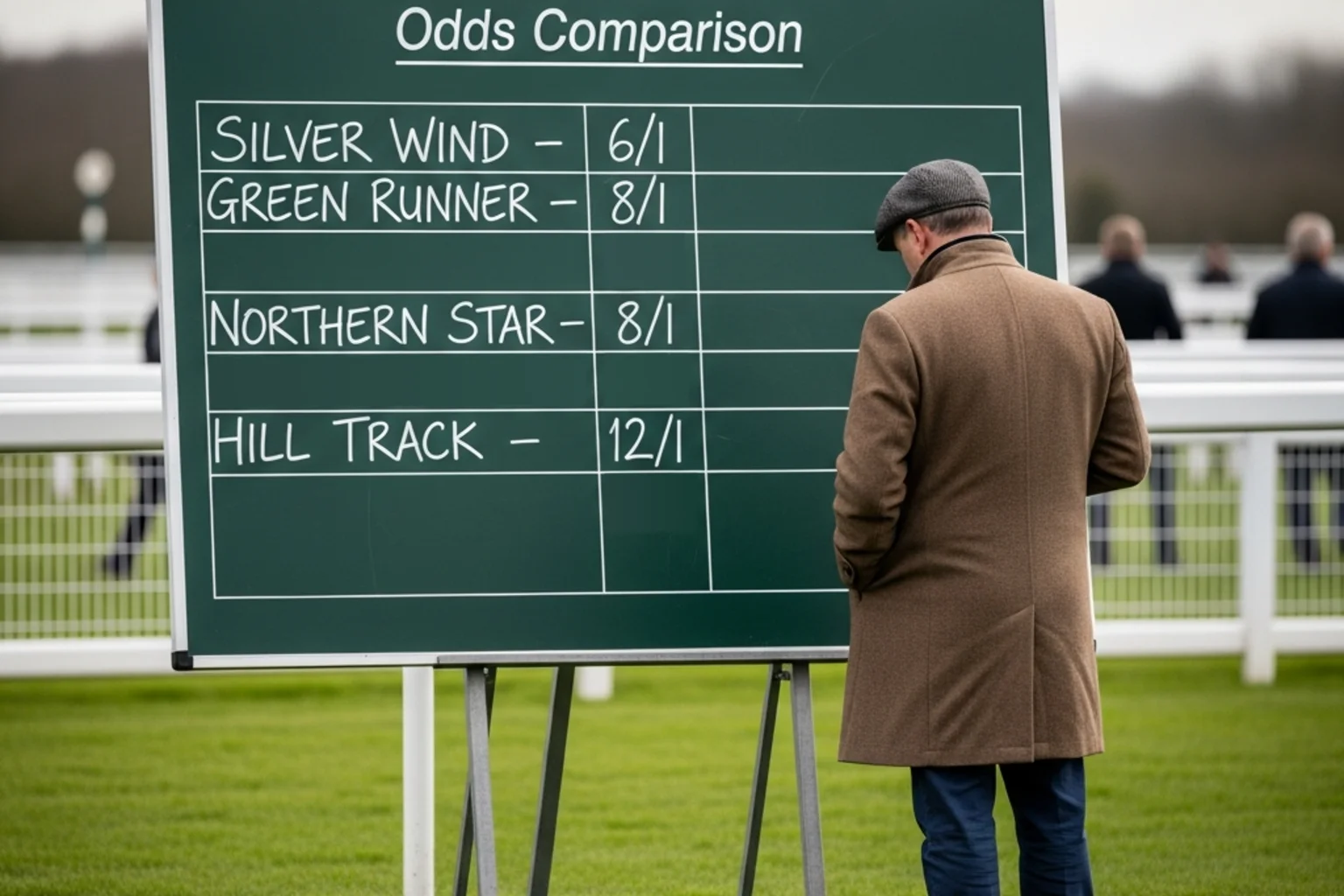
The best tip is getting the best price. Every Cheltenham selection becomes more or less profitable depending on the odds you take, and the price difference between bookmakers on the same horse in the same race can be significant. Across a festival where an estimated £450 million will be wagered in 2026, even marginal improvements in the odds you accept translate into real money over 28 races.
Most punters place their bets with whatever bookmaker they happen to have an account with, accept the price on screen, and move on. That convenience costs them. A horse available at 5/1 with one firm and 11/2 with another represents an immediate 10% improvement in potential return — for precisely the same bet on precisely the same outcome. Over a four-day festival with multiple bets per day, the cumulative effect of consistently taking the best available price is the single easiest way to improve your bottom line without changing a single selection.
Sharp moves are explained in market movers.
How Odds Work — A Quick Foundation
Cheltenham odds are typically displayed in fractional format — 5/1, 7/2, 11/4 — which tells you the profit relative to your stake. A £10 bet at 5/1 returns £60 (£50 profit plus your £10 stake). Decimal odds, more common on betting exchanges and European platforms, express the total return: 5/1 fractional equals 6.0 decimal (your stake multiplied by 6). Both formats convey the same information — use whichever you find more intuitive, but make sure you can convert between them when comparing across platforms.
Behind every set of odds sits an implied probability. A horse at 4/1 carries an implied probability of 20% — the bookmaker’s price suggests the horse wins roughly one in five times. At 2/1, the implied probability rises to 33%. Converting odds to implied probability is the foundation of value betting: if you believe a horse has a 30% chance of winning but the bookmaker’s odds imply only a 20% chance, the price represents value. The formula is straightforward — for fractional odds of A/B, the implied probability equals B divided by (A plus B). At 4/1, that is 1 divided by 5, or 20%.
The overround is the bookmaker’s built-in margin. In a perfectly fair market, the implied probabilities of all runners would add up to 100%. In practice, they add up to between 110% and 130%, depending on the race and the bookmaker. That excess — the overround — is how the bookmaker profits regardless of which horse wins. Lower overround markets give punters better value. At Cheltenham, the overround tends to be lower on the marquee races (Gold Cup, Champion Hurdle) where competitive pressure between bookmakers is fiercest, and higher on lesser races where fewer punters are comparing prices. Knowing this helps you focus your comparison efforts where they matter most.
How to Compare Odds Effectively
The most efficient way to compare Cheltenham odds is through an odds comparison website, which aggregates live prices from multiple bookmakers in a single view. These sites display the available odds for every runner in a race across ten, fifteen, or more bookmakers, highlighting the best price in the market. A quick glance tells you which firm is offering the most generous odds on your selection — and the difference can be substantial, particularly in the morning when bookmakers are still adjusting their markets.
The comparison process changes when Best Odds Guaranteed enters the picture. BOG is a feature offered by most major UK bookmakers that guarantees you the higher of two prices: the odds you take when placing your bet or the starting price at the off. If you back a horse at 4/1 in the morning and the SP is 5/1, BOG ensures you are paid at 5/1. This feature effectively eliminates timing risk — you no longer need to decide whether to bet early (for fear the price shortens) or wait (hoping it drifts). With BOG, you take the best available morning price and know the bookmaker will match any improvement.
At Cheltenham, where the average bet sits around £8.22, even a half-point of odds improvement matters across multiple bets. On a £10 bet, the difference between 4/1 and 9/2 is £5 in additional profit. Across 15 bets over four days, consistently taking the best price could mean the difference between a losing and a winning festival. The effort required — two minutes of comparison per bet — is negligible relative to the potential gain.
One practical tip: open accounts with at least three bookmakers before the festival begins. Odds comparison is useless if you can only bet with one firm. Having multiple accounts lets you place each bet at the best available price. Complete the identity verification process in advance — doing it on race morning when you are trying to get a bet on quickly is a recipe for missed prices and frustration.
The wider context is set out in our Cheltenham betting tips.
Identifying Value in the Cheltenham Market
Finding the best available price is the first step. The second — and more profitable — step is identifying when a price represents genuine value. Value exists when the odds offered by the bookmaker imply a lower probability of winning than your own assessment suggests. If you believe a horse has a 25% chance of winning and the bookmaker offers 5/1 (implied probability 16.7%), the price is value. If the bookmaker offers 3/1 (implied probability 25%), the price is fair. If they offer 2/1 (implied probability 33%), you are paying over the odds.
This sounds abstract, but it translates directly to Cheltenham selections. Consider a novice hurdler with strong Dublin Racing Festival form, proven Cheltenham course experience, and a trainer who has won the race three times in the last decade. Your assessment might put the horse at a 30% chance. If the market offers 4/1 (20% implied), you have a clear value bet. The price is generous relative to the horse’s realistic chance.
The discipline is in the assessment, not the betting. Most punters reverse the process — they find a horse they like, then look at the odds and decide whether they feel like value. Genuine value identification requires you to estimate the probability first, independently of the market, and then compare your figure to the bookmaker’s implied probability. This is harder than it sounds, which is why so few punters do it consistently. But at Cheltenham, where form data, trainer statistics, and going records are abundantly available, the raw material for probability assessment is richer than in almost any other betting environment.
One final caution: value is not certainty. A value bet at 5/1 will still lose roughly 80% of the time. The concept only works over a meaningful sample — dozens or hundreds of bets — where the edge compounds into long-term profit. At a single four-day festival, variance dominates. Take value where you find it, but do not expect every value bet to win. The goal is to make better-priced bets consistently, not to find guaranteed winners.
Better Odds Do Not Mean Lower Risk
Comparing odds and seeking value does not reduce the inherent risk of betting — it simply improves the terms on which you accept that risk. Never let the pursuit of value lead you to bet on races or horses you have not properly assessed. Set your festival budget before comparing a single price, and stick to it. If you need support, BeGambleAware is available on 0808 8020 133, free and confidential.
