
 Available in US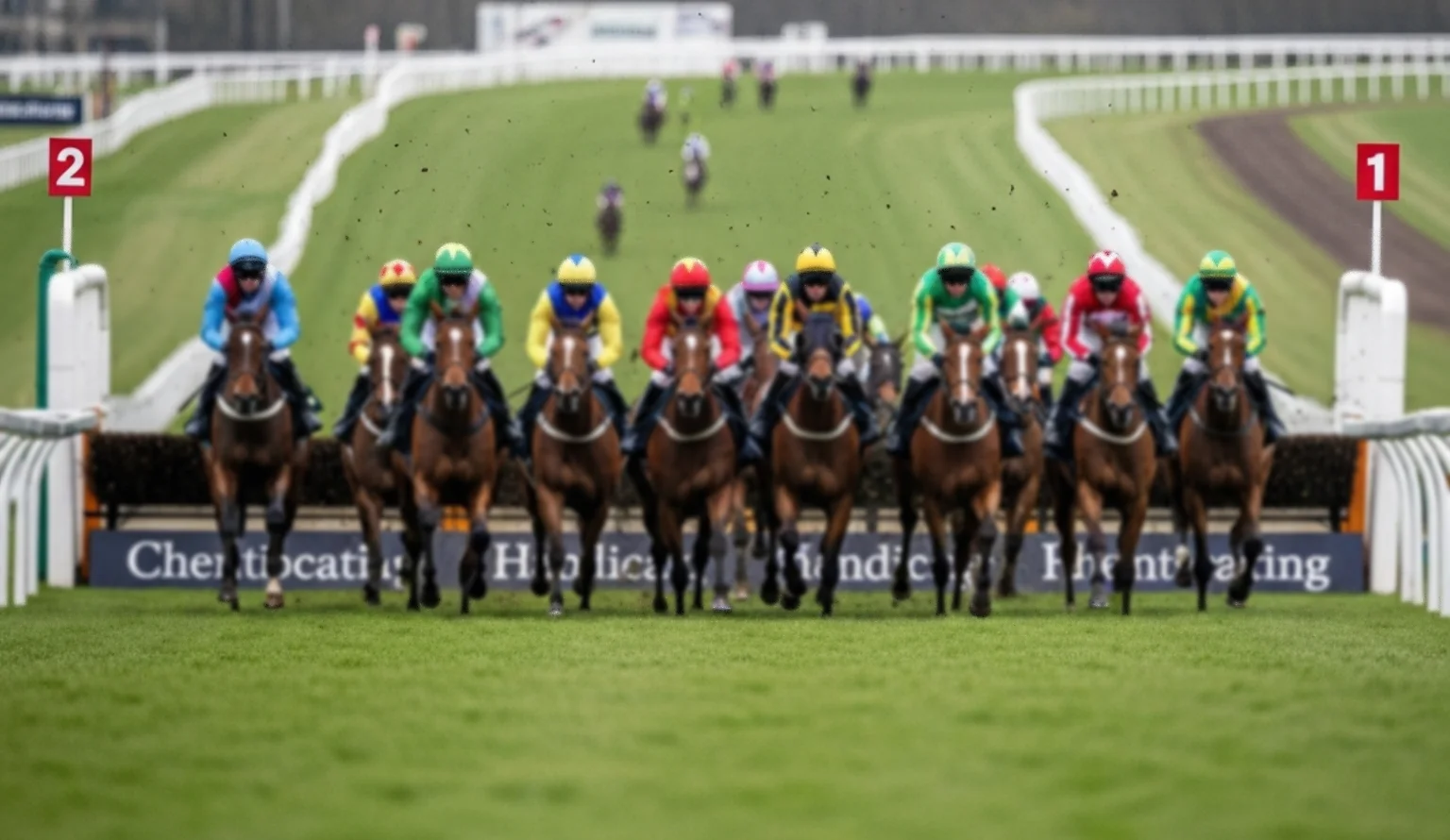
In Cheltenham handicaps, the form book is just the starting point. The festival’s handicap races — the Coral Cup, County Hurdle, Plate, Ultima, Martin Pipe, Grand Annual, and others — are where favourites go to lose and outsiders go to thrive. The Coral Cup’s favourite has won just twice in 25 runnings, an 8% strike rate that tells you everything about the competitive nature of these races. Fields of 16 to 24 runners, compressed handicap marks, and the festival atmosphere combine to produce results that confound the market with remarkable consistency.
For punters, Cheltenham handicaps are both the most dangerous and the most profitable races on the card. Dangerous because the variance is enormous — backing a single runner to win in a 20-horse field is statistically ambitious. Profitable because the market’s inability to separate the contenders creates value at every price point, especially at the bigger odds where each-way terms add a safety net.
Irish yards dominate these races: Irish trainers.
How Cheltenham Handicaps Work
A handicap race is designed to equalise the chances of every runner by assigning different weights based on the BHA’s Official Rating. The higher a horse’s rating, the more weight it carries. In theory, this means every horse in the field has an equal chance of winning. In practice, the system is imperfect — and those imperfections are where value lives.
At Cheltenham, the handicaps attract the festival’s largest fields because any horse within the rating band can enter. A typical festival handicap has a rating spread of 15 to 25 pounds between the top weight and the bottom weight. The top-rated horse carries more weight but is theoretically the most talented; the bottom weight is less proven but carries the lightest burden. The market tends to favour the top-rated horses — they are the ones with the best form figures — but the weight concession given to the lower-rated runners offsets that quality gap.
The key Cheltenham handicaps occupy every day of the festival. The Ultima Handicap Chase (Tuesday) is a three-mile chase. The Coral Cup (Wednesday) is a two-and-a-half-mile hurdle. The Plate (Thursday) is a chase over the same trip. The County Hurdle and Martin Pipe (both Friday) close the festival with big-field hurdle races. Each of these races has its own character, but they share the defining trait of handicap racing: unpredictability driven by competitive fields where the difference between first and tenth is measured in marginal advantages.
One subtlety that separates informed handicap punters from casual ones is the concept of a well-handicapped horse. This is a runner whose Official Rating, in the view of the bettor, is lower than the horse’s true ability. It can happen for several reasons: the horse has been brought along slowly by its trainer with a low-key campaign designed to keep the mark down; the horse improved dramatically in its most recent run but the handicapper has not yet reassessed; or the horse has been running over an unsuitable trip or on unsuitable ground and its rating reflects those below-par performances rather than its ceiling. Identifying a well-handicapped horse is the central skill of festival handicap betting — and it requires reading beyond the raw form figures to understand why a horse has run as it has.
Field Size and Why It Changes Everything
The number of runners in a race is the single most important structural factor in handicap betting. In a championship race with eight runners, the favourite’s implied probability of winning might sit at 30% to 40%. In a 20-runner handicap, the favourite’s implied probability drops to 12% to 18% — and the actual probability is often even lower because the handicap system is designed to compress the field.
Larger fields create more each-way value. Standard place terms pay four places in races with 16 or more runners at one-quarter the win odds. In a 20-runner Cheltenham handicap where the favourite is 8/1 and you back a 16/1 shot each-way, the place part pays 4/1 for a top-four finish. Given that the field is compressed by the handicap, finishing in the first four from 20 runners is a realistic proposition for any horse in the top half of the market.
Field size also increases the impact of race-day variables that are impossible to predict from form: traffic problems in running, pace setups that suit hold-up horses or front-runners, the draw (less relevant at Cheltenham than on flat courses, but not irrelevant in big-field hurdle races where inside positions have a slight advantage). The more runners, the more variables — and the more variables, the less predictable the outcome. For favourite backers, this is a nightmare. For each-way punters and value seekers, it is an opportunity.
The Irish Raider Edge
The most powerful trend in Cheltenham handicap betting is the rise of the Irish raider. The share of Irish-trained winners in festival handicaps has surged from 35% between 2015 and 2019 to 58% between 2020 and 2024. That shift represents a fundamental change in the competitive landscape, and it has not been driven solely by the super-trainers. Of the 55 Irish handicap victories in that period, only 10 came from Willie Mullins. The remaining 45 were distributed across Gordon Elliott, Gavin Cromwell, Joseph O’Brien, and a host of smaller operations.
The explanation lies partly in the cross-border handicapping challenge. Horses trained in Ireland are assessed by the Irish Handicapper based on Irish form, then compete in Britain against horses assessed by the BHA. The two systems do not always agree on relative ability, and the evidence suggests that Irish-trained handicappers frequently arrive at Cheltenham with Official Ratings that understate their quality. This is not cheating — it is a structural feature of operating across two separate rating jurisdictions.
For punters, the practical approach is straightforward: give Irish-trained runners additional respect in any big-field Cheltenham handicap, particularly those arriving with form from the Dublin Racing Festival or the major Irish winter meetings. When an Irish-trained runner shows up at 14/1 or 16/1 in a festival handicap with form that looks ordinary by British standards, it may be ordinary by Irish standards too — or it may be a horse whose true ability has not been captured by its Official Rating. The Irish handicap surge suggests the latter happens often enough to make it a consistently profitable angle.
The trainer profile matters within the Irish contingent. Elliott and Cromwell have been particularly effective in festival handicaps, running multiple entries and spreading their chances across different race types. Look for Irish runners whose trainers have specifically targeted a Cheltenham handicap — a horse entered only in the Martin Pipe, rather than in three different races, signals a trainer with a clear plan for that specific contest. Targeted entries from proven festival trainers, combined with form that hints at untapped ability, represent the strongest handicap betting angle the festival offers.
The wider context is set out in our Cheltenham betting tips.
High Variance Demands Moderate Stakes
Handicap betting is inherently high-variance. Even the best analysis will produce more losers than winners in 20-runner fields. Accept that reality before placing a single bet, and size your stakes accordingly — handicap races are not the place for maximum stakes. Each-way at moderate unit sizes is the sustainable approach. If you need support, BeGambleAware is available on 0808 8020 133, free and confidential.
